Saturday, April 16, 2016

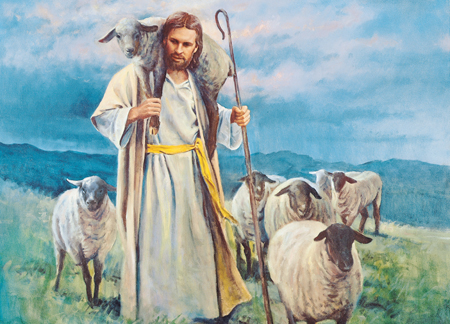
THE GOOD SHEPHERD AND THE GOOD SHEEP


Fourth Sunday of Easter
Good Shepherd Sunday and the World Day of Prayer for Vocations
Acts 13: 14. 43 – 52 / Ps 100 / Rv 7:9. 14b – 17 / Jn 10: 27 – 30

What is your status in life? A status is your official position in a social group. That is why in our society, some are married. Some are single for a period of time while others are single forever and ever. To those who are neither married nor single, they would just say, “It’s complicated!”

Today is Good Shepherd Sunday. Let us no longer debate whether Jesus is a Good Shepherd or not. Rather, let us reflect on our status as the sheep of the Good Shepherd. Let us ask ourselves, “Am I a good sheep?” “Am I faithful to my status as a sheep of the Lord?” Jesus in our Gospel presents to us three qualities of a good sheep. “My sheep hear my voice; I know them, and they follow me.” To listen, to know, and to follow the Good shepherd make us his good sheep.

“My sheep hear my voice.”
It is very difficult to hear the voice of the Good Shepherd today because the world is noisy. From the rising of the sun to its setting, we hear a lot of voices. However, to be a good sheep means being able to listen to the voice of the shepherd in prayer. Benedict XVI once reminded us that “only in silence is God revealed in our lives.” Thus, it is important that in our prayer we must allow God to speak so that we can listen to His voice. And so, let me ask you, “do you still pray?” “How often do you pray?” “And when you pray, do you allow God to speak to you?”

“I know them.”
There is no question about God knowing us. But do we know him? St. Paul reminds us that “faith comes through hearing.” Therefore, when we listen to God in prayer, then, we are also knowing who he is in our lives. It is important to know God because St. Augustine reminds us that “we cannot love that which you do not know.”

“They follow me.”
We live in a world of concrete and not abstract realities. And so, our knowledge about God must have a flesh. It must be seen in our lives. Thus, if we know that God is loving, then be loving. If we know that God is generous, then be generous. If you have not known God then you have not yet loved him.

Today is also the World Day of Prayer for Vocations. A vocation is different from a status. As I mentioned earlier, a status is your official position in a particular society. However, a vocation is your path to holiness. That is why to be a blessed single, to be married, or to be a priest or religious is your way to holiness. And you can only achieve holiness if you listen, know, and follow the way of the Good Shepherd.

A priest once shared with me the story of her former teacher. Mam Rose was a manager of the finance department of a big hospital in the city. She was so dedicated to her work that everything must be perfect for her. Since, she was working in the hospital, she was also able to meet and listen to the stories of the patients. Learning a lot from her stories, she came to a point wherein she slowly let go of her status as the finance manager and eventually ended being a volunteer in the chaplain’s office. Since she was already a volunteer, then, it came to a point that she was already begging for funds from other people. Indeed, it was a 360O turn of her life. When asked about her present life she said these words. “When I was a finance manager, I had everything. I can buy anything. However, when I volunteered in the chaplain’s office, I can no longer have everything. I cannot buy anything. But I was happier than before.”

Mam Rose did not only change her status. Mam Rose lived well her chosen vocation. She heard God through the patients. She knew about God through the patients. She followed God by serving the patients. And such kind of life made her happy. Indeed, she was a good sheep.

What is your vocation in life? Have you lived well your chosen vocation? Have you listened, known, and followed the Lord through your vocation? Are you a good sheep? Or are you a ba-ba-black sheep? Amen!

Saturday, April 9, 2016

DOMINUS EST!


Third Sunday of Easter
Acts 5: 27 – 32. 40 – 41 / Ps 30 / Rv 5: 11 – 14 / Jn 21: 1 – 19 or 1 –  14

“Where do broken hearts go? Can they find their way home?” asks the late Whitney Houston. When you lose a loved one, where do you go? When your friend became a traitor, where did you go? At kung pinaasa ka lang ng iyong minamahal na may forever pero wala pala, where do you go? Usually, when things are no longer bright and clear, we go back to our old way of life.

This is the case of Peter and the other disciples. Since Jesus, their Teacher, was no longer with them, they went back to their old way of life. Since Jesus, their Master, was no longer teaching, they went back to fishing, their original livelihood. Simon Peter said, “I am going fishing.” They replied, “We also will come with you.” Indeed, it was a life without Christ. However, despite their skill, they caught nothing all night. When it was dawn, Jesus standing on the shore gave them an instruction to cast their net on the right side of the boat. But him they did not recognize, not after that big catch, and the disciple whom Jesus loved recognize him and said, “Dominus est!” (It is the Lord!)

From the Gospel, we learn that living a life without God is nothing. Without God, our net of life catches nothing. However, living a life with God means filling our boats with a big catch. Pope Benedict XVI reminds us that “if we let Christ enter into our lives, we lose nothing, nothing, absolutely nothing of what makes life free, beautiful, and great. No! Only in this friendship are the doors of life opened wide. Only in this friendship is the great potential of human existence truly revealed.”

My dear friends, in life, when things become vague and life seem ordinary and routine, we easily fall out of love. Now that the Semana Santa is over and summer has begun, we go back to our old life. After having gone through Confession, now we go back to doing again and again our favorite sins. However, let us remind ourselves today that living a life without God is nothing.

This is our challenge: that we recognize the presence of the Lord amidst the ordinariness of life. That like John, we can also say, “Dominus est! It is the Lord!” Because to recognize him means having a big catch, fullness of life! Let us always remember that since the Lord has risen, he is already beyond time and space. Therefore, he is present not only every Semana Santa, but in every day of our lives. However, it is not enough to only recognize the Lord in our lives, as Christians, we should also become instruments, or witnesses for others to see the Lord in their lives. Kana ganing kung makakita sila nato makaingon sila, “It is the Lord!” Dili unta nga kung makakita sila nato makapanguros sila niya moingon pa gyud, “Sus naana na sad ang panuway!” (That similar situation that when they see us – how we carry ourselves in the things we say and do -- they can say, “It is the Lord!” Hopefully it is not the other situation, that upon seeing us – how we carry ourselves in the things we say and do -- they make the sign of the cross and exclaim: “Here is the devil once more.)

A story of a madre and Manong Estrelitto became viral in social media after the madre posted one of her experiences in Facebook. After the Visita Iglesia during the last 51st IEC, the madre took a taxi back to her convent near Harisson Plaza. However, the road was getting dark and winding and so the madre reminded the driver that she is going to Harisson Plaza. And it was only there that the driver admitted his fault. He, all the while thought that the madre was going to Radisson Hotel. Admitting his fault, he turned the meter back to zero and went to Harisson Plaza. But the story did not end there. Upon disembarking at her destination, Manong Estrelitto did not accept the madre’s payment. “Sister, huwag na po. Tulong ko na po sa misyon ninyo (Never mind Sister, please accept it as my help in your mission)” But the sister insisted, “Manong, you need this for your family.” But again the driver said, “Hindi po ako makakasali sa IEC, at wala naman akong maibibigay na iba. Yan na lang po ang contribution ko para sa IEC (Since I cannot participate in the IEC, and there is nothing I can contribute to the event, please accept it as my contribution to the IEC)”

My dear friends, on the one hand, Manong Estrelitto recognized the presence of God amidst his ordinary life as a taxi driver. On the other hand, Manong Estrelitto became the madre’s reminder of God’s presence amidst the ordinary.

Now, “Where do broken hearts go? Can you find your way home? Can you recognize God in the ordinary scheme of things? Life without God is nothing. But a life with God is everything. Find him. See him in the ordinary. He is there and it is the Lord! Amen.

Saturday, April 2, 2016

MERCY SEEN AT ITS BEST


Second Sunday of Easter
Today, the Octave of Easter, is also Divine Mercy Sunday
Acts 5: 12 – 16 / Ps 118 / Rv 1: 9 – 11. 12 – 13. 17 – 19 / Jn 20: 19 – 31

What do you fear most in life? When we are in fear, we tend to close ourselves from the object of our fear. Psychology today has a long list of phobias – the fear of heights, of closed spaces, of spiders, of darkness, of water, and even the fear of facing oneself in the mirror. Just as we cannot run away from utangs in life, we also cannot escape from the reality of fear.

This is the case of the disciples in our Gospel reading today. John tells us that for fear of the Jews, they locked themselves inside a room. Doors and windows were closed. You can just imagine how fear-filled that room was. However, amidst their fear, Jesus came and stood in their midst bringing with him the grace of peace. This time fear turned into peace with the presence of Jesus. Why such transformation? Because Jesus opened up himself to them; He also opened the closed and locked hearts of the disciples. And He went further as to allow Thomas to touch the marks of his wounds.

My dear friends, this Sunday is indeed a very special day because we celebrate Divine Mercy Sunday in the Jubilee Year of Mercy. What a double celebration of God’s mercy! Pope Francis in his book, The Name of God is Mercy, defines “mercy” from its Latin term, “misericordis.” The term “misericordis” contains two more Latin terms, “miseri” which means “wretchedness or misery” and “cordis” which means “heart.” Thus, for Pope Francis, mercy is the “opening of one’s heart to wretchedness.” And this is what Jesus did in our Gospel today: he opened up himself, his heart, to the disciples who were in fear.

However, it is not enough to open up ourselves to the sufferings of others. Jesus, because of Thomas’ doubt, offered to him the wounds of his body to be touched. Jesus’ openness however was not a mere show but it was something real, personal, and concrete. This is an important element of mercy. Pope Francis reminds us that mercy is not like a soap opera. No! God’s love, his mercy, is solid, strong, and concrete. “It is a concrete love made of works and not of words.”  

My dear friends: most especially this year, we are asked to be “merciful like the Father.” And we can only become merciful like the Father if, like Jesus, we open up our hearts to the suffering of others in the most real, personal, and concrete way possible. We must not only stand in the midst of fear and suffering. Rather, we should allow others to touch our lives. Or we should allow ourselves to be dirtied, bruised, and wounded so that others will believe; so that others will experience the peace of the Risen Lord.

In 1864, Damien, a Belgian priest arrived on the shores of Honolulu, Hawaii as a missionary. When leprosy became a health issue during that time, the island of Molokai became a leper colony. Seeing the need for pastoral care, Fr. Damien volunteered to be the chaplain of the lepers. While in Molokai, Fr. Damien administered not only to the spiritual but also to the physical needs of the lepers. He made coffins for them and even washed their bloodied linens. Such was his dedication until one day, he himself was afflicted with leprosy, and it led to his death in 1889. In a letter to his brother he said, “I make myself a leper with the lepers to gain all to Christ.” The story of Fr. Damien is a story of God’s mercy. Fr. Damien opened up himself to the suffering of the lepers in the most real, personal, and concrete way! This is a story of mercy seen at its best!

Now let me go back to my first question, “What do you fear most in life?” I hope you don’t include in your list the fear of being merciful to others. I hope you are not afraid of opening up yourself, your heart, in the most real, personal, and concrete way possible, to the suffering of others. Amen!


Special thanks to Kuya Chris Sagun for the editing of the text. 


Saturday, March 26, 2016

FINDING OUR JOY


Easter Sunday of the Lord’s Resurrection
Acts 10: 34. 37 – 43 / Ps 118 / Col 3: 1 – 4 or 1 Cor 5: 6 – 8 / Jn 20: 1 – 9

One early morning, I was awakened by the voice of my father. Since, we were in the retreat house, he was calling home because he was asking my mother about his sandals. He could not find them. After spending some search and rescue operation inside the room, my father paused in silence and found his sandals. Do you know where he found them? He was already wearing them! In life, we always try our best to find things because having them can make our work effective. When you misplace your cellphone, then, you look for it because having your phone makes you more effective in communicating with others. We even search for people because having them around gives us inspiration and comfort. Kaya nga yung iba sa atin, mahanap at makita lang ang picture ni crush sa Facebook, ok na ang araw nila! Simply said, having found the exact things and right persons in life gives us joy.

This is also the case in our Gospel reading today. Mary Magdalene and the disciples were looking for Jesus. When Peter went inside the tomb, he did not find Jesus but only the burial linens. And if we move forward the story, John tells us that Mary Magdalene stayed outside the tomb weeping. She was weeping because Jesus was nowhere to be found. But her sorrow turned into joy when the Lord appeared to her. And such joy of finding Christ led her to run with joy to the disciples carrying with her the joy of the Resurrection.

In our world today, technology has succeeded in providing us with many opportunities for pleasure but it has never given us joy. This is the great paradox – yes, people are rich, famous, and powerful but their lives are empty, sad, in despair. Thus, we ask ourselves, where can we find joy? Pope Francis in Evangelii Gaudium boldly proclaims that “with Christ joy is constantly born anew.” And so, like Mary Magdalene, we can only find joy in an encounter with Christ.

After seeing Christ, Mary Magdalene brought her joy to the disciples. This too is our challenge today. After finding joy in the resurrection of Christ, then, we share, we give such joy to others. Blessed Paul VI beautifully reminds us that “joy cannot be dissociated from sharing. In God, all is joy because all is giving.” My dear friends, we are an Easter people because our joy comes from the Risen Lord. Today, may I invite you to find the Risen Lord so that you will have joy. And in finding him, never forget to share such joy with others!

I started my homily with the story of my father. Let me then end with another story of another father who is living in one of the condominium buildings in Taguig. He was “on top of the world” because of his high paying job, his loving and beautiful wife, and his responsible daughter. However, he admitted to me that his life was empty. He was looking for real joy. One day, he decided to stroll outside the business district and landed visiting a prison facility. He joined the group that was visiting the prisoners. After a few days, he found himself again visiting the prisoners until it became a regular part of his week’s schedule. He became so close with the prisoners even to the point of attending their court hearings. Despite the negative reactions from his friends, he insisted on his prison visit because according to him, he found joy in his friendship with them.

My dear friends, Mary Magdalene found Christ in the empty tomb and that father found Christ in the face of the imprisoned. How about you? Have you found Christ? Where have you found him? Amen.


Friday, March 25, 2016

A GREAT CHANGE


THE SACRED PASCHAL TRIDUUM:
THE EASTER VIGIL IN THE HOLY NIGHT
Gospel: Luke 24: 1 – 12

“The only thing constant is change,” says the philosopher Heraclitus. Since it is inevitable in life, then, we have mixed and different reactions when we talk about change. There was once a son who upon returning home told her mother that he is graduating magna cum laude from college this April. And so, the mother was overjoyed with the news. But the son added, “Ma, aside from my graduation this April, you will also become a lola because my girlfriend is giving birth next month!” And the mother raged in anger. Indeed, we have mixed and different reactions when we are confronted with change.

In our Gospel this evening, there was a sudden change of events. The burial place of Jesus was found empty. And how did the characters react to such change? The women who brought spices at the tomb were puzzled and terrified with the news. Luke also tells us that for the disciples the story of the women was nonsense and did not believe them. Peter who went to the tomb was amazed with what he had seen. Indeed, we have mixed and different reactions when we are confronted with change.

Our celebration tonight marks a very significant change in our faith life. In the readings that we heard, we find a lot of changes. In the story of creation, there was a change from chaos to order. In the story of the Exodus, there was a change from slavery to freedom. And our Exultet boldly proclaims to us that “this is the night when Christ broke the prison bars of death and rose victorious from the underworld.” This is therefore the important change that happened to our faith – that the Lord whom we believe and adore is not sleeping inside the darkness of the tomb. Rather, Jesus, our Lord, is truly, fully, and really alive! Thus, we sing with the angels, “Alleluia, alleluia, alleluia!”

Now we ask ourselves, how shall we react to this change? What must be our response to such a wonderful change? Paul in his letter to the Romans tells us that like Jesus who lives for God and dies no more, we too must think of ourselves as “being dead to sin and living for God in Christ Jesus.” This change that we receive this holy night must lead us to change ourselves – from sinfulness to grace, from having died because of sin to living for God in grace. I hope that as we change season from Lent to Easter, our celebration tonight will be the beginning of our life’s change for the better.

And so, we pray to our Risen Lord…

“Change my heart oh God,
Make it ever true.
Change my heart oh God,
May I be like You.

You are the potter,
I am the clay,
Mold me and make me,
This is what I pray.”
Amen.


Thursday, March 24, 2016

REMAIN IN MY LOVE


THE SACRED PASCHAL TRIDUUM:
FRIDAY OF THE PASSION OF THE LORD
Is 52:13-53:12 / Ps 31 / Heb 4: 14-16; 5: 7-9 / Jn. 18:1-19:42

“And bowing his head, he handed over the spirit.”
Jesus who was born in Bethlehem is now hanging lifeless on his Cross at Calvary.
Jesus who fed the hungry is now fed into the hands of righteous people.
Jesus who walked along the shores of Galilee is now walking along the way of the Cross.
Jesus who brought joy to the woman caught in adultery is now met by her sorrowful mother and the weeping women of Jerusalem
Jesus who gave life to many has now given his life as a ransom for our sins.

If you look at the Cross of Jesus, what do you see? We see a Jesus whose look was beyond human semblance. We see a Jesus who was betrayed by his chosen friends. We see a Jesus who was mocked and cursed by the people. We see a weeping mother standing at the foot of her son’s cross. Indeed, what a dark, dry, and dull scene at Calvary.

However, despite the people’s mockery, Jesus asked his Father to forgive them. Despite the pain, Jesus gave heaven to the repentant thief. Despite the sorrow, Jesus entrusted Mary to the disciple and the disciple to Mary. Despite the hatred of his enemies, Jesus handed over his spirit to the Father. And why was Jesus able to do these things in the midst of pain and suffering? It is because only love remained in his heart. He was simply fulfilling his instruction to his disciples at Last Supper to “remain in love.”

My dear friends, there is much pain and suffering in our world today. Every day, our families face a lot of problems, concerns, and worries of the future. Faced with all these, there is a strong temptation for us to fall out of love and turn to “lesser loves” – money, power, and fame. However, Jesus Crucified has set for us an example – that even if everything will be taken away from us, our hearts must not stop beating in love, in God’s love. Despite the hatred, we must love. Despite the indifference, we must love. Despite the difficulty, we must love. And even in the face of death, we must remain in love.

Almost three years ago, while I was still in the seminary, after dinner, I received a call from my sister. She informed me that my mother was rushed to the ICU for an unknown illness. I have to fly back to Cebu early morning the following day. When I arrived she could no longer speak. After lunch that same day, her eyes forever closed. She was no longer my mother who was so alive and “talkative.” I must admit she was nearing death. And true enough, at 1045 in the morning of the following day she breathed her last. Reflecting from that experience, I realized that even if my mother was no longer able to see and speak; and even if she lost her life, what remained until today is her love for me and my family. Every time, I find life heavy and burdensome, I call on her. Every time, life becomes difficult, I call on her. And I am sure that until today her love remains in my life because St. Paul reminds us that love “endures all things, hopes all things, believes all things… and that love does not end.”

My dear friends, no matter how we preserve life, we must admit that it will never be perfect. But life is still beautiful. It is still good to live this life. And the reason for this is God’s love. And so, let us every day remain in God’s love. Amen.  


Wednesday, March 23, 2016

“THE HOUR HAS COME”


THE SACRED PASCHAL TRIDUUM:
THURSDAY OF THE LORD’S SUPPER
Ex. 12: 1-8.11-14 / Ps 116 / 1 Cor. 11: 23-26 / Jn. 13: 1-15

The Book of Qoheleth has always told us that there is a “time for everything.” There is a time to get rich and a time to become poor; a time to live and a time to die; a time to be kicking and a time to be sleepy; a time to fall in love and a time to be brokenhearted. However, what is more important and crucial is that if that time has come for us. Yes, there is a time to die, but what if it is your time to die? Yes, there is a time to be brokenhearted, but what if it is your time to be brokenhearted?

In our Gospel today, John tells us right at the beginning of his narrative that the time / the hour has come for Jesus to pass from this world to the next. If in Genesis, Adam tried to grasp divinity for himself. In our Gospel this evening, Jesus moved towards the opposite direction. Jesus took on human flesh for him to take hold of us. And this movement of Jesus is brought about by love. But we ask ourselves, what kind of love? Commenting on the washing of feet, Benedict XVI has this to say that “the gesture of washing feet expresses precisely this: it is the servant – love of Jesus that draws us out our pride and makes us fit for God.”

My dear friends, as we begin the first day of our Triduum for Easter, we are reminded today that our time has come, the hour has come for us to also move away from our sinful self towards grace. The time has come for us to leave our proud self and move towards the other. And this movement can only happen if we have a “servant – love.” For this transformation to happen, our love must be like a servant – it must be humble. A love that listens to others. A love that forgets the self for others even to the point of losing your own life.

Last March 4, we heard about the murder of 4 Missionaries of Charity Sisters in Yemen by the ISIS. Aside from the four, it was also reported that there was a Salesian priest named Fr. Tom who was abducted by the gunmen. Just last Holy Monday, I saw in Facebook, a report that there was an information about Fr. Tom being currently tortured. It was also said that he will be crucified on Good Friday by his abductors. Why am I telling you this? Because the lives of the 4 sisters and Fr. Tom are best examples of this so-called, “servant – love.” These Christians were not military people. They were not armed with guns and grenades. They were simply serving the poor and the old. They were simply serving others in love.

How about us? What kind of love do you have for your family, for your husband, for your wife, for your children, for your relatives? Is it a “servant – love?” Is it a love that washes the feet of others? Is it a love that pushes you to serve others in humility?


My dear friends, the time has come. The hour has come for you and me to leave sin and love the Lord and others through our humble service. Time’s up! Turn away from sin and turn to Jesus, our servant – lover. Amen.