Thursday, March 17, 2016

AN OBEDIENCE TO DIVINE LOVE


Palm Sunday of the Lord’s Passion
Alay Kapwa Sunday
Is 50: 4 – 7 / Ps 22 / Phil 2: 6 – 11 / Lk 22: 14 – 23: 56 or 23: 1 – 49

“He humbled himself, becoming obedient to death, even death on a cross.”

My dear friends, what we heard was not simply a narration of an event in the past. The passion and death of Jesus is love seen at its best. What he went through was the result of his obedience to the Father. “It is not obedience to a father who will his son to die – for what parent would ever wish such a fate on their child?” Rather, Jesus’ obedience even unto death is obedience to Divine Love. Since love is about assuring the other that he/she is not alone, then, Jesus had to undergo every kind of human misery and endure every human suffering except sin in order to prove to us that he is in love with us, the worst of sinners!

As Christians, this is also our challenge every day of our lives – that we remain obedient to Divine Love. Despite the many imperfections in the family, in our work, and in our community, we must not fall out of love. Amidst pain and suffering, we continue to remain obedient to love the way Jesus did -- He who never gave up on his loving despite the heavy cross.

What we heard earlier was a long passion narrative which took place almost 2000 years ago in Jerusalem. At this point, let me narrate to you a shorter passion narrative. This happened last March 4, barely less than a month, at the Missionaries of Charity Retirement Home in Aden, Yemen. This narrative is taken verbatim from the journal of the witness and sole survivor of the bloodshed:

“Friday, Midday, 4th of March 2016. Sisters had Mass and breakfast as usual. As usual Father steps back in chapel to say prayers then to fix things around the compound.
8:00am – said Apostolate prayer and all 5 went home
8:30am – ISIS dressed in blue came in killed guard and driver. 5 Ethiopian men (Christian) began running to tell the Sisters ISIS was here to kill them. They were killed one by one. They tied them to trees, shote them in the head and smashed their heads.
The sisters ran 2 by 2 in different directions as they have mens and ladies home. 4 working women were screaming “Don’t kill the Sisters! Don’t kills the Sisters!” One was the cook for 15 years. They killed them as well.
They caught Sr Judit and Sr Reginet first, tied them up, shot them in the head, and smashed their heads. When the sisters ran in different directions, the Superior ran to the Convent to try to warn Father Tom.
They caught Sr Anselm and Sr Marguerite tied them, shot them in the head, and smashed their head in the sand.
Meanwhile the Superior could not get to the convent. It is not clear how many ISIS men were there. She was all the sisters and helpers killed. The ISIS men were already getting to the Convent so she went into the Refrigerator Room since the door was open. These ISIS men were everywhere searching for her as they knew they were 5. At least 3 times they came into the Fridgerator Room. She did not hide but remained standing behind the door. They never saw her. This is miraculous.
Meanwhile at the Convent, Father had heard the screaming and consumed all the Hosts. He had no time to consume the large Host so he threw the oil out of the sanctuary lamp and dissolved it in the water. A neighbor saw them put Father Tom in their car. They did not find any trace of Father anywhere. All religious articles were smashed and destroyed – Our Lady, Crucifix, altar, tabernacle, lectionary stand – even their prayer books and Bible.
10 or 1015am – the ISIS men finished and left.”

The four sisters were obedient not only to their religious congregation; more importantly they were obedient to Divine Love. It was this love that allowed them to remain faithful to their vocation.

How about us? What keeps us moving today? What binds us together as a family? What makes you faithful to your husband, your wife, your father, your mother, your children, and your friends? 

I hope that we be like Jesus… like the four Missionaries of Charity sisters who remained obedient to Divine Love even in death. Amen.


Special thanks to Kuya Chris Sagun for the editing work. 
Photo taken from www.bigcatholics.com

Friday, March 11, 2016

LOOKING AT THINGS DIFFERENTLY


Fifth Sunday of Lent
Is 43: 16 – 21 / Ps 126 / Phil 3: 8 – 14 / Jn 8: 1 – 11

Since we do not come from one mother, then, we look at things differently. For example, what do you see in this picture?

For some they might see a rabbit while others may see a duck with a long beak. How about this picture, what do you see?


For those who love to drink, they would probably see a cup filled with wine. However, for those Dolce Amore fanatics, they would surely see Serena and Ten-Ten almost kissing each other. We do not only see things differently; we also understand things and events differently. For example, on the prospect of Duterte becoming the President of the Philippines: for some it will be a blessing while others may consider it a curse! Indeed, we see things differently. We understand realities differently.

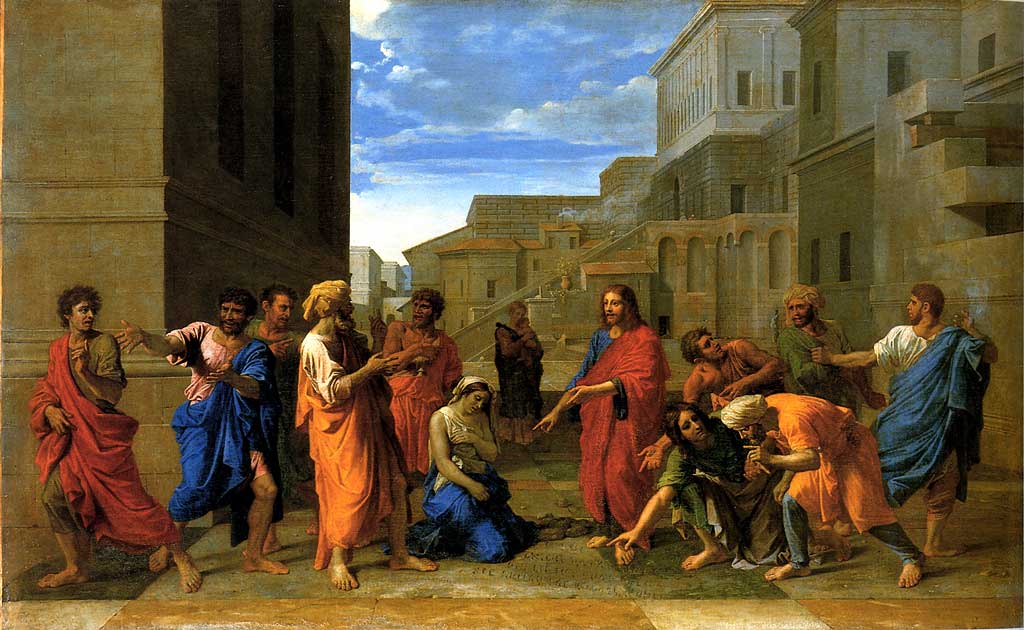
In our Gospel today, we meet a woman caught in the act of committing adultery. And so, this woman was brought by the scribes and Pharisees to Jesus and made her stand before him. For the scribes and Pharisees, they look at the woman as a sinner and therefore punishable by death according to the Law of Moses. However, we know from the same Gospel story that Jesus looked at the woman differently. Jesus looked at her with the eyes of mercy and forgiveness. Indeed, Jesus understand the Law of Moses differently. For him, love is supreme of all laws. Hence, as he stood up after writing something on the ground, seeing no one else left except the woman, he forgave her and admonished her not to sin anymore.

My dear friends, this is also true in our spiritual life. We look at the things of God differently. We understand the things of God differently. For example, in this season of Lent, in this Year of Mercy, we are called to practice, to put to life, Jesus’ teaching on forgiveness. Now, the question is: how do you look at the call to forgive? Well, for some, it’s easy to forgive. Dali masuko apan dali ra sad mahuwasan. For others, it’s very difficult to forgive. Moingon dayon ang uban, “moputi nalang na'ng uwak, di gyud ko makapasylo nimo!” In fact, still others, kaya ra gyud nila ang magbinungolay sa usa’g usa hangtod sa kamatayon. Indeed, we look at things differently. See how we tend to understand things differently?

However, my dear friends, as followers of Christ, we are called to look at things, to understand things, as Jesus see them, as Jesus understand them. If Jesus understand forgiveness as something that must be done seventy times seven times, then, we have to practice it in our lives. If Jesus understand loving as something that is for all, then, we love not just the lovable but even the mga pangit… kanang mga bati na'g nawong, bati pa gyu'g batasan. If Jesus understand generosity as giving your all, then, we give our all and not on installment basis.

Yes, we look at things differently. But as children of the Father, as brothers and sisters of Jesus, we must look at things and understand things according to the mind and heart of Jesus.

Just recently, America magazine published a story of a woman named Jeanne – an attorney – who forgave the murderer of her sister, her sister’s husband, and her sister’s unborn child. It was an intentional killing. And what was worse, the murderer did not show any sign of remorse. When asked what moved her to forgive the murderer, she said, that she was deeply moved by the words she recite every Mass – “You take away the sins of the world.” For her, a person must not allow the sin of someone to freeze or stay unforgiven. For her, no matter what a person does, we must be ready to take away his/ her sins.

For me, Jeanne is an example of someone who see things and understand things according to the mind and heart of Jesus. Yes, I agree with you – to forgive is something very difficult. But we also have to remember that it is very very possible.

How about you? How do you look at things? How do you understand things? Are your eyes like the eyes of Jesus? Is your mind like the mind of Jesus? Is your heart like the heart of Jesus? Amen.

Photo taken from lifeondoverbeach.wordpress.com
Special thanks to Kuya Chris Sagun for editing the text. 


Friday, March 4, 2016

A MERCIFUL EMBRACE FROM GOD


Fourth Sunday of Lent (Laetare Sunday)
Jos 5:9. 10-12 / Ps 34 / 2 Cor 5: 17 – 21 / Lk 15: 1-3. 11-32

When was the last time that you received a very tight hug or a warm embrace from someone? Just as laughter is the best medicine, hugging therapy is also considered a powerful way of healing. The respected family therapist, Virginia Satir, has this to say, “We need four hugs a day for survival. We need eight hugs a day for maintenance. We need twelve hugs a day for growth.”

Our Gospel parable this Sunday is unique to Luke. Pope Francis in his document on mercy mentions the Parable of the Prodigal Son as one of the Gospel references on God’s mercy. Well, I guess every one of you here knows about this parable. This is as famous as Dolce Amore!

The story begins with the younger son asking for his share of his Father’s wealth that should come to him. Such gesture of the son was a great insult to his father. It was like wishing his father dead! Having received his share, the son went away and enjoyed all kinds of wine, women, and song. And since, material possessions are temporary, the son found himself in dire need. He was so in need of money that he worked in feeding the pigs. What the son experienced was a great insult to him. For the Jews, pigs are unclean animals. And so, feeding them makes someone even more unclean than the swine. Coming to his senses and take note not out of guilt and remorse, the son decided to go back to his Father. Then came the most moving scene of the Gospel, while the son was walking towards home, the father caught sight of him and ran immediately towards him. Upon seeing his son face to face, he gave him a very tight embrace, a warm hug from a father. No words uttered but simply an assuring embrace, a forgiving hug. What the father did was not a mere welcome but mercy at its best! Love seen in the most concrete way!

My dear friends, the story of the Prodigal Son is also our own story. Because of our sins especially our “favorite sins,” we insult God’s generosity. We all the while think that our sinfulness can give us the best brand of happiness in life. However, we are wrong. We must remember that we are created in the image and likeness of God. Therefore, to live in sin is a great insult to our identity as children of God. And so, we turn to God for mercy. We ask God for his assuring embrace and forgiving hug. All that we need to do is to humbly accept our sinfulness and open our hearts to the voice of God who has long been waiting for us.

However, my dear friends, you who have experienced God’s merciful embrace are also tasked to share such embrace with others. In this year of mercy, we are reminded of our call to be merciful like the Father!

After the funeral Mass of one of his priests who was brutally murdered by the fundamentalists, Bishop Lampon was asked by the media, “Will you not leave this place? You and your priests have been in hot and difficult waters already. You might lose your life anytime.” The humble bishop replied, “We will not leave this place. Rather, we will continue to extend our hands of forgiveness to those people who hate us even if it will cause our very own lives.” Indeed, there is no fear in the life of such Bishop because he has been assuredly embraced by the Father in heaven. Bishop Lampon simply was merciful like the Father.

“We need four hugs a day for survival. We need eight hugs a day for maintenance. We need twelve hugs a day for growth” says a family therapist. But we only need one tight hug, one merciful embrace from the Father in order to live life in abundance. Amen. 

Wednesday, February 24, 2016

CALLED TO BECOME A “BURNING BUSH”


Third Sunday of Lent
Ex 3:1-8a,13-15 / Ps 103 / 1 Cor 10:1-6,10-12 / Lk 13: 1-9


We are living today in a culture of accumulation. Since our desires are insatiable, then, every day we ask for more. We look for more. We want more! Since others want more food, then, they prefer a buffet than a value meal. Since others want more fun and excitement in their married life, then, they prefer to have an extra or more husbands and wives. Since others want to be more “confidently beautiful by the heart,” then, they accumulate more beauty products from facial cream to whitening soaps. Kung pwede lang sana gamitin ang muriatic acid sa mukha, matagal na itong ubos sa mga supermarkets. Since our wants never subside, every day we accumulate more and more.

In our first reading today, while Moses was tending the flock, he saw a bush though burning was not consumed. Upon closer look, it was God speaking to him through that burning bush about His plan of saving the Israelites out from the slavery in Egypt. In our Gospel, Jesus tells us of a parable about the fig tree that has been without fruit for three years already. Since the owner found nothing, the gardener requested to give him another year to cultivate the tree so that it may bear fruit in the future.

The two images presented in our two readings today remind us of two realities in life today. Some of us are like the burning bush. Despite the fire of pain and suffering we have to go through in life, we continue to give light to others. We continue to be of service to others. However, some of us are like the fig tree. Since every day we wake up with a lot of problems, then, we become unproductive. All that we do is to accumulate all for ourselves.

My dear friends, as Christians, we are called to become like the burning bush; that despite the fire, it continues to give light and is never consumed. Despite our pain and suffering, we continue to be active and  productive for others. Let us not be like the fig tree that has been barren for three years. Let us not believe on the saying, “if you can’t beat them, join them.” Let us not succumb to the evils of the world and simply say, “what can we do?” Let us produce good works so that we can introduce the truth of God in our world today.

This is the purpose of the season of Lent – that we fix our gaze to the Crucified Lord. Yes, if we look at the cross, we see a body heavily bruised and wounded. However, do not also forget, that every time we look at the cross, we are reminded of that scene on Calvary. Despite the agonizing pain and suffering, Christ produced forgiveness by pardoning those who mocked at him. “Father, forgive them for they do not know what they are doing.” Despite the agonizing pain and suffering, Christ produced heaven by assuring the repentant thief, “Today, you will be with me in Paradise.”

My dear friends, the Galileans in our Gospel today died not because they were greater sinners than the rest but because of Pilate’s malice. The Jerusalemites at the fall of the tower of Siloam died not because they were greater sinners than the rest but simply because they were at the wrong place and at the wrong time. The parable of the barren fig tree, however, tells us that to be inactive and unproductive in our Christians lives is the “greater sin.”

GMA’s Pinoy Abroad once narrated to us the story of Emy who was a domestic helper. After sometime, she was diagnosed to have suffered from a very serious illness. Upon knowing about her wife’s sickly condition abroad, the husband, who was in the Philippines, left Emy for good. And so, her two children were left to the care of her mother. Despite her sickness and family condition, Emy until today continues to work abroad. Despite her sickness, she continues to send some of her income to her children. Despite her sickness, she continues to produce hope and love.


How about us? How about you? Are you a “burning bush” who produces life despite the fire? Or are you like a “fig tree” who remains unproductive and inactive? We are here on this world not in order to accumulate all for ourselves but to produce good works of faith, hope, and love. Amen. 

Friday, February 19, 2016

FAVORITE PLACES


Second Sunday of Lent
Gn 15: 5-12. 17-18 / Ps 27 / Phil 3: 17-4:1 / Lk 9: 28-36

We all have our own choice of favorite places. We go to these places more often because we encounter either something or someone that gives us joy. That is why for some, a buffet restaurant is a place to go because they encounter food which gives them joy. For others, a sari – sari store which is “debt – friendly” (okay lang ang utang) is a favorite place because they encounter a stress free and no worry store. Well, I wonder why the Mactan Bridge or the roof decks of buildings are the favorite places of the brokenhearted. We favor these places because they give us favorable experiences and meaningful encounters.

In our Gospel today, Jesus went up to his favorite place which is the mountain. He usually goes up to the mountain in order to pray and during moments of decision making. In the earlier chapter of Luke, Jesus went up to the mountain to pray before choosing his twelve collaborators, his disciples. Today, Jesus went up to the mountain to pray because he will now open another chapter in his ministry. From Galilee, he will now move to Jerusalem to fulfill the plan of God. And it was on the mountain, while he was at prayer, that his plan of moving to Jerusalem was confirmed and strengthened in his dialogue with the two great men of the Old Testament, Moses the Lawgiver and Elijah the Prophet. It was on the mountain that he gained strength in pursuing with his Jerusalem ministry. It was on the mountain that he encountered divinity.

My dear friends, as Christians we too have our own favorite place. And what is our favorite place? It is the Church. Yes, the Church! And I am not only referring to the building but the Church as the People of God. We who are gathered here together in the Eucharist. And why the Church? Benedict XVI reminds us in Deus Caritas Est that our religion is not a lofty idea or a result of an ethical choice but an encounter with an event, a person who gives life meaning and a new direction. The Church is our favorite place because it is in the Church where we can truly encounter the Lord who gives meaning and direction to our lives.

This is therefore our challenge that we who are part of this favorite place called the Church must become Christians who allow others to encounter Christ through our life witness. Our Church today must be a reality that consoles and inspires others so that they too will make the Church as their favorite place. And this we can do by living out in daily life our encounter with the Lord. If in the Church, you encountered a God who is generous, then, be generous. If in the Church, you encountered a God who is forgiving, then, be forgiving. Only when you make concrete your encounter with God will others consider to make the Church their favorite place.

Who can forget the sharing of Ms. Sarindhorn from Thailand during the recently concluded 51st IEC. At 20 years old, she earned a degree in Businees Administration from the US. At 25, she co-founded a finance company in Thaiand. At 30, she was the biggest stockholder of the company. According to her, she was “on top of the world!”  Then lightning struck her life. Since the stock exchange crashed in Thailand, she has to sacrifice herself in exchange of the savings of the depositors who were mostly Catholic schools. Exhausted from work, she resigned. When the new bank director took over, she was grilled. She was falsely accused of stealing almost 7.8 million dollars. With all the problems in life, she reached the point of ending her life. She was empty handed! Then on December 25, 1989. She had her faith experience with God. She realized that God was touching her life. And so such experience with God led her to forgive her enemies. 

Ms. Sarindhorn’s favorite place was her occupation. However, such occupation gave her the worst experience in life. She almost lost her mind. But it was also through her worst experience that she encountered the Lord. How about us? How about you? What is your favorite place in life? Has such place given you the experience of encountering the Lord? If not, please leave such place right now. Amen.


Photo taken from stjoenbtc.org

Thursday, February 11, 2016

EASY TO STAY OUT THAN GET OUT


FIRST SUNDAY OF LENT
National Migrants’ Sunday
Dt 26: 4 – 10 / Ps 91 / Rom 10: 8 – 13 / Lk 4: 1 – 13

The Irish novelist, Oscar Wilde, has this to say, “I can resist anything except temptation.” Indeed, all of us have our own share of temptations. For those on a diet, it is always a temptation to ask for more… for more food! For those who want to have a better future, it’s always a temptation to gain more money as easy as possible! And for those who are loveless this Valentine’s Day, it’s always a temptation to be bitter and have a pusong bato today!

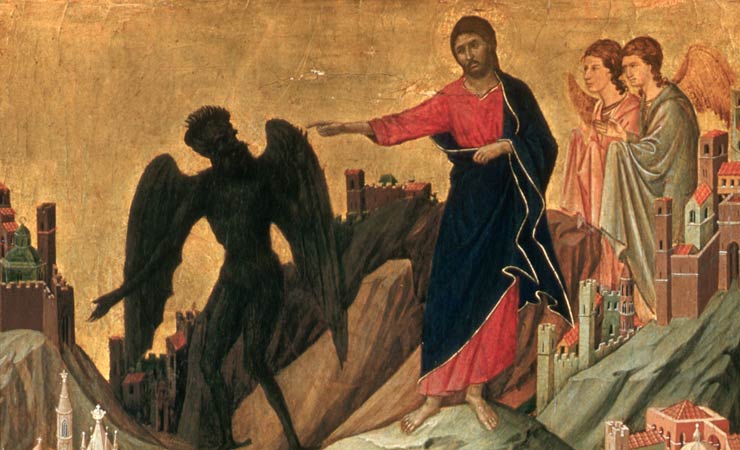
Even Jesus in our Gospel was tempted not once but thrice in the wilderness. “If you are the Son of God, command this stone to become bread.” Jesus was tempted to love pleasure than God. “I shall give to you all this power and glory… if you worship me.” Jesus was tempted to love possessions than God. “If you are the Son of God, throw yourself down from here…for he will command his angels to guard you.” Jesus was tempted to love protection than God. Love for pleasure, power, and protection were the three temptations the devil offered to Jesus. However, Jesus did not give in to these “lower loves” because he has always chosen the highest love who is God.

The temptation for pleasure, possession, and protection is also our own temptation. Since we want to be always comfortable, then the devil offers his pleasure. Since we want to have a name in society, then the devil offers his possession. Since we want to be stable and secure, then the devil offers his protection. However, my dear friends, we are called to be like Jesus – that we resist these temptations by always CHOOSING GOD.

And our first two readings today give us the reason why we must choose God. We must choose God because Moses in our first reading reminds us that God hears our cries; he sees our affliction and oppression like what happened to the Israelites while they were in Egypt. We must choose God because St. Paul tells us in our second reading that “everyone who calls on the name of the Lord will be saved.”

My dear friends, the presence of temptations also reminds us of the presence of God in our lives. For what use is the temptation if there is no opposing force on the other side?  The devil tempts us because he is aware that there is also a God who constantly invites us to be with him. What matters in the end therefore is our decision either to give in to the devil’s offer or give way for God’s grace to enter into our lives. Jesus was able to resist the temptations of the devil because Luke tells us right at the start of the Gospel that Jesus was “filled with the Holy Spirit.” We during our Baptism received the Spirit and we were strengthened in Confirmation with His gifts. We too therefore can resist temptations no matter how strong they may be because the Spirit is also in us. Let us therefore call on the Spirit to inspire us every time we are to make a decision in choosing either the lower loves of pleasure, possession, and protection or the highest love who is God. Let our responsorial psalm be our prayer today and forever, “Be with me, Lord, when I am in trouble.” Be with us Lord, now and forever.


The American novelist, Mark Twain has this to say, “it is easier to stay out than get out.” It is easier to stay out from sin by resisting temptation rather than getting out from the tight net of sin. Therefore, in our effort to resist temptation and choose God let us remember the words of the apostle James, “Resist the devil and he will take flight. Draw close to God, and he will draw close to you!” Amen.


Photo taken from postbarthian.com

Friday, February 5, 2016

CONTRASTING REALITIES


Fifth Sunday in Ordinary Time
Pro – Life Sunday
Is 6: 1 – 2. 3 – 8 / Ps 138 / 1 Cor 15: 1 – 11 / Lk 5: 1 – 11

We live in a world of contrasts. Some are illiterate but rich while some are literate but living in poverty. Some are growing upward while some are increasing sideward. Some are having problems on what to eat from the buffet while some are having problems on how to earn money in order to eat. Some are ugly from the outside yet beautiful from the inside while some are beautiful from outside yet ugly from the inside. We live in a world of contrasts.

This is also the common theme in our liturgy today. We see in the three readings the contrast between the lack of human capacity and divine generosity. In our first reading, the prophet Isaiah after seeing the vision of God’s glory, realized his unworthiness when he said, “Woe is me, I am doomed! For I am a man of unclean lips living among a people of unclean lips.” In our second reading today, Paul reminded the Corinthians that the Gospel which he preached to them was handed on to him despite his unworthiness to be called as an apostle for he was “born abnormally” and “persecuted the Church of God.” In our Gospel reading, Peter after experiencing the miraculous catch of a great number of fish, felt his unworthiness even to the point of requesting Jesus, “Depart from the Lord, for I am a sinful man!” Yet despite their unworthiness and lack of human capacity, Isaiah, Paul, and Peter were chosen and sent by God to become “fishers of men.”

With this contrast between human lack and divine excess; between our limited nature and God’s unlimited nature, we realize that in our relationship with God it is not about our worthiness but about His tremendous mercy and compassion for you and me. Such reality must be enough for us to rejoice in life. Despite our human weakness God has chosen us to become his people, his children.

My dear friends, if we look around us, we see a lot of contrasts due to human greed and selfishness. Yes, there are many buffet restaurants in the city, yet many are dying everyday because of hunger. Yes, there are many rising condominium buildings in the metropolis, yet many continue to live under bridges and in shanties. Yes, there is a fast development of technology, yet green forests are becoming scarce. Yes, we praise human beauty, yet we neglect the right to life of the unborn. We rejoice because we have been chosen by God despite our weakness. Yet, we are chosen because we are on a mission to end these contrasting realities in our world today.

While we were travelling from the Calungsod chapel towards the back portion of the Template during the Closing Mass of the 51st IEC, I saw towards my left, the many dirty and weak shanties of the poor. Towards my right, I saw a sea of Catholics waiting for the Mass to begin despite the heat of the sun. What a great contrast! But in between the shanties of the poor and the people was the altar where the Eucharist will be celebrated. Thus, I realize that in the Eucharist, Jesus calls us to gather around the altar despite our unworthiness. And from our gathering, he sends us to the poor, the sick, and the marginalized. Amen.


Photo taken from frmarkdwhite.wordpress.com